
How we compared book tracking apps
"Best" is meaningless without criteria, so here are ours. They are the same six questions we would ask before trusting any app with years of reading history:
- Privacy default — Where does your reading data live? On your device, or only on someone's server?
- Account requirement — Can you track a single book without signing up?
- Offline use — Do shelves, notes, and progress work on a plane or in a dead zone?
- Social pressure — Is there a feed, follower count, or public profile you have to manage (or actively opt out of)?
- Tracking depth — Shelves, ratings, read dates, sessions, notes, quotes, goals, stats.
- Import / export — Can you bring your Goodreads history in, and can you leave later with your data intact?
One bias to declare up front: Leafed is our app, and this is the Leafed blog. We have kept the competitor descriptions factual and flagged where each rival genuinely beats us — the same standard we use in the full feature comparison matrix.
Comparison at a glance
| App | Account | Offline-first | Social feed | Sessions / timer | Import & export | Best for |
|---|---|---|---|---|---|---|
| Leafed | Optional | Yes | None | Timer + manual sessions | Goodreads/StoryGraph CSV in; CSV/JSON out | Private, complete tracking |
| Goodreads | Required | Limited | Core product | No (challenge only) | CSV export | Largest review network |
| StoryGraph | Required | No | Community / discovery | Progress, not a timer | Goodreads import; export available | Mood-based recommendations |
| Literal | Required | No | Core (follows, clubs) | Progress tracking | Import and export marketed | Quotes and social reading |
| Hardcover | Required | No | Core (feeds, lists) | Typically no timer | Goodreads/StoryGraph import | Modern community catalog |
| Bookly | Typically yes | Partial (timer works locally) | None | Core product (timer, streaks) | Varies; some export behind premium | Timer gamification & habits |
1. Leafed — best for private, complete tracking
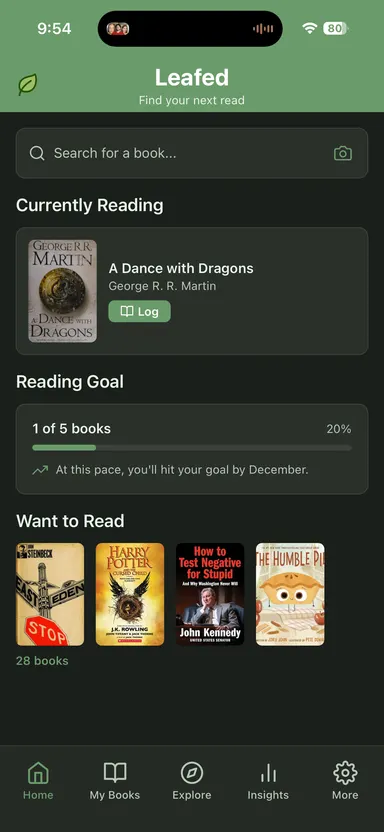
Leafed is built on one idea: your reading log is yours. You can download it on iOS or Android and start tracking immediately — no account, no email, no onboarding quiz. Shelves (Want to Read, Reading, Finished, DNF, plus custom shelves), ratings, notes, quotes, reading sessions with a live timer, annual goals, and stats all live on your device and keep working offline.
Adding books is faster than most trackers: scan a barcode and the book is in your library in seconds. Coming from Goodreads or StoryGraph, a CSV import brings your shelves, ratings, and read dates over — and Kindle readers can import every highlight from My Clippings.txt as quotes. And the exit door works too — you can export your entire library as CSV or JSON at any time, which is rarer among trackers than it should be.
Where it wins: privacy default (on-device data, no ads, nothing sold), no account requirement, offline everything, deep tracking (sessions, notes, quotes, goals, stats), honest import and export, free forever.
Where it loses: there is no social discovery. No friend activity, no community reviews, no mood-based recommendation engine, and no Bookly-style gamified timer with achievements and ambient soundscapes. If other readers are how you find books, pair Leafed with a library app or browse — or pick a social tracker below.
Detailed matchups: Leafed vs Goodreads · Leafed vs StoryGraph · Leafed vs Bookly.
2. Goodreads — best for review scale and friend activity
Goodreads is still the default for a reason: nearly every book ever published has a page, thousands of reviews, and lists attached to it. If your reading life is social — buddy reads, book clubs, seeing what a friend rated a title before you commit — no other app matches the network's size.
As a tracker, though, Goodreads has barely moved in a decade. There are shelves, star ratings, and the annual Reading Challenge, but no reading sessions, thin personal stats, and an interface that mixes your log with ads and Amazon links. Your shelves are public by default, and everything requires an account on Amazon-owned servers.
Where it wins: review corpus, friend network, ubiquity — every author and giveaway is there.
Where it loses: privacy, tracking depth, offline use, and the general feeling that you are the product. The full breakdown is in Leafed vs Goodreads.
3. StoryGraph — best for mood-based recommendations and stats storytelling
StoryGraph is the strongest Goodreads challenger and the best pick if discovery is your priority. Its mood and pacing system ("dark, tense, medium-paced") powers recommendations that genuinely work, and its stats pages — mood breakdowns, pace charts, format splits — are the best-presented in the category.
It is, however, an account-based online service. There is no offline-first library, the community and discovery layer is central to the product, and some analytics sit in the paid Plus tier. StoryGraph is a better social tracker than Goodreads for most people; it is not a private one.
Where it wins: recommendations, mood tagging culture, stats presentation, independence from Amazon.
Where it loses: account required, online-only, freemium stats. See Leafed vs StoryGraph for the head-to-head.
4. Literal — best small-community social reading
Literal is the boutique option: a clean, well-designed social reading app built around following people whose taste you trust, sharing highlights and quotes, and joining book clubs. If Goodreads feels like a mall and StoryGraph like a recommendation engine, Literal feels like a nice bookshop with regulars.
The trade-off is that it is social by design. An account is required, the feed is the product, and tracking depth (sessions, granular stats) is not the focus. Full comparison: Leafed vs Literal.
5. Hardcover — best modern community catalog
Hardcover is the community-built, ad-free Goodreads replacement: rich lists, per-book privacy options, goals, and an active community shaping the catalog. It is the closest thing to "Goodreads rebuilt in the 2020s," and its list culture is excellent.
Like the others in this group, it assumes an account and a cloud-first product; there is no offline-first mode, and reading-session tracking is not the emphasis. See Leafed vs Hardcover.
6. Bookly — best reading timer and habit gamification
Bookly comes at tracking from the habit side. The live timer is the core loop: start a session, read, stop, and watch streaks, reading-speed estimates, and time-to-finish projections accumulate. Achievements and ambient sounds make it genuinely motivating if streak mechanics work on you.
Its limits are the mirror image of its strengths: the library and shelving experience is thinner than a full tracker's, the free tier caps books and shows ads, and the most useful stats live behind the subscription. Leafed has a timer and sessions too, but Bookly's gamified timer experience — targets, streak celebrations, soundscapes — is deeper, and we say so plainly in Leafed vs Bookly.
Where it wins: timer UX, streaks, habit motivation.
Where it loses: freemium limits, thinner shelf/notes depth, less clear data custody and export.
Honorable mentions: spreadsheets and notes apps
A spreadsheet
Genuinely underrated. A Google Sheets or Excel reading log gives you total control of columns, zero lock-in, and charts if you want them. The costs are friction — every book is typed by hand, cover art and metadata are on you — and the fact that a cloud spreadsheet is only as private as the account it lives in. If you go this route, our free book tracking spreadsheet template gives you a sane column layout to start from.
A notes app
Apple Notes, Notion, or Obsidian can hold a perfectly good reading list, and they are unbeatable for long-form reflections. What they lack is structure: no read-date fields, no ratings you can sort, no stats, and search that degrades as the list grows. Fine for a dozen books a year; painful for a decade of history.
Switching trackers without losing your history
The most common reason readers stay on an app they dislike is sunk history — years of shelves and ratings feel too heavy to move. In practice, switching is a small job as long as both ends support CSV:
- Export from the old app. Goodreads: My Books → Import and export → Export Library (arrives as a CSV email link). StoryGraph: Manage Account → export. Both include shelves, ratings, and read dates.
- Import into the new one. In Leafed, the import lives in Settings — point it at the CSV and shelves, ratings, and read dates map across. A few hundred books take a couple of minutes; odd editions occasionally need a manual match.
- Keep the CSV. Whatever app you land on, that file is your insurance. Re-export once or twice a year and your history stops depending on any company's roadmap.
Two warnings from experience. First, reviews and private notes travel less reliably than shelves — check what your export actually contains before deleting the old account. Second, run both apps in parallel for a week or two before committing; the tracker you like in screenshots is not always the one you reach for at 11 p.m. with three pages left in a chapter.
How to choose in 30 seconds
- "I want my reading log private, offline, and mine." → Leafed.
- "I want an app to tell me what to read next." → StoryGraph.
- "My friends are all on it and that's the point." → Goodreads (or Literal for a smaller circle).
- "I need streaks or I stop reading." → Bookly.
- "I want Goodreads, but modern and ad-free." → Hardcover.
- "I trust no app." → a spreadsheet, with our template.
Whichever you pick, check the exit before you move in: an app without export deserves none of your history. Every option above except some Bookly tiers offers a real export path, and Leafed's Goodreads/StoryGraph import means switching is an afternoon, not a rebuild.
Related reading
- Full book tracker feature comparison matrix
- Best private & offline book trackers (2026)
- Best Goodreads alternatives for privacy
- Leafed vs Goodreads · vs StoryGraph · vs Literal · vs Hardcover · vs Bookly
- Reading log apps: keeping a digital reading log
FAQ
What is the best book tracker app in 2026?
There is no single winner — it depends on why you track. Leafed is the best private, offline-first tracker with no account required. StoryGraph wins on recommendations, Goodreads on community scale, Bookly on habit gamification.
Do book tracking apps require an account?
Most do. Goodreads, StoryGraph, Literal, and Hardcover are online services where the account is the product's foundation. Leafed works fully without one — the free sync account exists only if you want your library on multiple devices or the web.
Can I track the books I read without Goodreads?
Yes. Goodreads lets you export your library as CSV, and both Leafed and StoryGraph import it — shelves, ratings, and read dates included. You keep your history without keeping the account.
What is the best free book tracking app?
Leafed's core tracking is free with no ads and no premium wall. Goodreads is free but ad-supported. StoryGraph and Bookly are freemium — usable free, with stats or unlimited books behind a paid tier.